Our research, published in AACRAO’s Strategic Enrollment Management Quarterly, explores why funding, visa, and housing readiness deserve a greater place in graduate enrollment strategy.
By Adi Pathak | Co-Founder & CEO, CASA
In October 2026, my article, Yield Is Won After Admission: An Admit-to-Arrival Readiness Model for Global Graduate Enrollment, was published in Strategic Enrollment Management Quarterly (SEMQ), a publication of the American Association of Collegiate Registrars and Admissions Officers (AACRAO), as part of its special issue marking 50 years of enrollment management.
The publication represents an important milestone for CASA, but more importantly, it opens a conversation about graduate student readiness and a part of the student journey that deserves greater attention.
A deposited student is not necessarily a ready student.
That is the central argument of the article, and something we have come to understand through years of working in higher education and supporting incoming graduate students.
Institutions invest significant resources into recruitment, admissions, financial aid, and enrollment strategy. Yet for many graduate students, some of the most consequential decisions begin after receiving their acceptance letter.
Where will they live? How will they fund their education and relocation? Will their visa be ready? Who will they turn to for help? And how will they begin building a sense of belonging in an unfamiliar environment?
These questions may appear to sit outside traditional enrollment management. Our research suggests they are deeply connected to it.
Read the published article in Strategic Enrollment Management Quarterly, Volume 14, Issue 3.
The graduate student journey has changed. Has our approach kept pace?
Graduate enrollment presents challenges that differ from the traditional undergraduate experience.
Graduate students may be entering higher education after time in the workforce, moving with partners or families, or making significant financial and professional commitments. International students may be coordinating these decisions across countries, currencies, immigration requirements, and unfamiliar housing markets.
At the institutional level, graduate education is often decentralized. Academic programs, admissions teams, international student services, financial aid, and student affairs each play important roles, but they may operate with different timelines and responsibilities.
The result is that students can receive helpful information from several offices and still struggle to understand how everything fits together.
Consider an international graduate student who receives an admission offer but is still awaiting a departmental funding decision. That uncertainty may affect the documentation needed for visa planning. Without clarity on funding and arrival timing, committing to an apartment becomes difficult.
From an institutional perspective, these may be separate administrative processes.
For the student, they are one interconnected decision.
And that’s the disconnect we wanted to better understand.
What 150 incoming graduate students told us
Between May 2025 and May 2026, CASA engaged 150 incoming students admitted to U.S. graduate programs through one-to-one, interview-style conversations.
Approximately 135 were headed to Boston, and 120 were international students living outside the United States at the time of engagement.
We asked each student one open-ended question:
“What are the top three things you are stressed about when you receive the admission letter?”
Their responses revealed a consistent pattern.
Rather than focusing exclusively on academic preparation, students frequently raised concerns about off-campus housing, roommates, visa timing, funding, and the practicalities of beginning life in the United States.
Housing was a particularly prominent concern, often closely connected to affordability, roommate uncertainty, and limited familiarity with the local rental market.
The more we examined these conversations, the clearer it became that students were trying to make several interconnected decisions, often without a single source of guidance connecting them.
Our inquiry was practice-based and primarily Boston-focused. It was not designed to measure national prevalence or establish a causal relationship between readiness support and enrollment outcomes.
What it offered was an operational perspective on the challenges students were navigating after admission.
Those observations became the foundation of the admit-to-arrival readiness model.
Three timelines shaping graduate student readiness
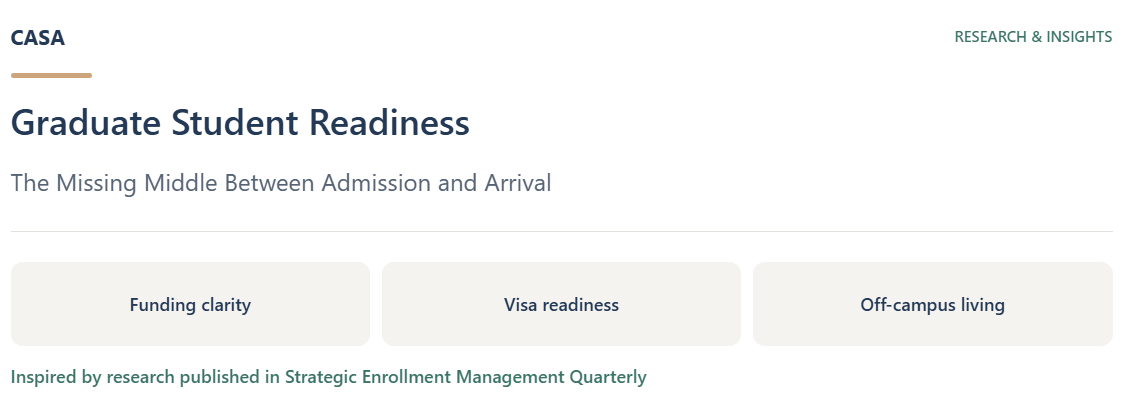
The framework published in SEMQ identifies three interconnected timelines that can influence a student’s ability to move from admission to arrival.
1. Funding clarity
An admission offer does not always provide a complete financial picture.
Graduate students may be coordinating scholarships, assistantships, external loans, family contributions, living expenses, and payment timelines. These decisions can involve different departments and providers, sometimes operating on different schedules.
For international students, funding clarity may also influence proof-of-funds documentation, visa planning, and housing commitments.
The institutional opportunity is to help students move beyond receiving financial information to understanding a realistic pathway forward.
2. Visa readiness
Visa preparation is often treated as a distinct administrative process, appropriately managed by international student services and relevant government authorities.
But students experience visa timelines alongside other decisions.
A delayed appointment may affect travel. Uncertainty around arrival timing may complicate housing commitments. Outstanding documentation or funding questions can create additional pressure.
The opportunity is not to move immigration responsibilities away from the appropriate experts. It is to improve coordination and help students understand how these milestones relate to their broader arrival plans.
3. Off-campus living
For many graduate students, particularly those entering urban institutions, housing is one of the earliest and most consequential decisions they make.
Students must navigate neighborhoods, rental costs, documentation, lease terms, guarantor requirements, roommate arrangements, and move-in schedules.
For students unfamiliar with the local rental market, even understanding where to begin can be difficult.
Universities do not need to become landlords or housing brokers. But recognizing off-campus living as part of the enrollment readiness journey creates opportunities for earlier housing education, credible referral pathways, and more coordinated student support.
These three timelines do not operate independently. That is what makes them so important.
A funding delay can complicate visa preparation. Visa uncertainty can affect housing plans. Housing concerns can influence a student’s confidence about arriving.
Graduate student readiness is not simply about completing three checklists. It is about helping students navigate the decisions connecting them.
Why we built CASA around this gap
The research reflects a problem I had come to recognize from multiple perspectives.
As an international graduate student, I experienced the complexity of moving to the United States firsthand. Later, during five years working at Babson College, conversations with students, parents, and international education partners helped me see how these practical challenges intersected with the institutional enrollment journey.
Universities were working hard to support students, but many of the questions families were asking extended beyond the traditional responsibilities of any one campus office.
When Gillian Dunn and I founded CASA, we wanted to help address that gap.
We believed incoming graduate students needed more than access to information. They needed human support to understand their options, coordinate next steps, and begin establishing life beyond campus.
Today, CASA supports domestic and international graduate students from acceptance through their first academic year.
Our human-led approach brings together practical services across the student journey, including:
- Before arrival: Personalized readiness conversations, funding-resource navigation, visa-process education and appropriate referrals, housing planning, and roommate coordination.
- Housing and settling in: Curated housing navigation through licensed partners, support understanding local rental processes, move-in coordination, and connections to banking, transportation, furnishing, and other local essentials.
- Community and belonging: Graduate student connections, local experiences, member benefits, and continued support as students establish their lives beyond campus.
What makes this model different is not that each service is new. It is the effort to connect them around the individual student’s needs.
We also recognize that institutions are not starting from zero.
Many already have excellent international student services teams, student affairs programs, housing resources, and graduate admissions support.
Our goal is to complement those resources, not compete with them.
CASA’s institutional approach is modular, built around each institution’s priorities, existing support infrastructure, and student population.
For one institution, that may mean strengthening off-campus housing navigation. For another, it may mean more personalized pre-arrival engagement, coordinated referrals, or practical transition support.
The underlying principle remains the same: give students clearer pathways while helping institutions extend their existing capacity thoughtfully.
What this means for institutional enrollment strategy
One of the central ideas in the SEMQ article is that readiness indicators deserve consideration alongside traditional yield indicators.
Applications, offers, deposits, and enrollment numbers help institutions understand student decisions.
Readiness indicators can provide additional insight into whether students are positioned to act on those decisions.
Has a student established a realistic funding pathway? Do they understand their visa milestones? Have they identified viable housing options? Do they have an arrival plan?
These are operational questions, but they can reveal friction that traditional enrollment reporting may not capture.
For institutions, this creates an opportunity to strengthen cross-functional communication, identify concerns earlier, and better understand the student experience between admission and arrival.
External partners can play a role when they provide clearly defined, consent-based support that complements institutional resources.
At CASA, we believe this work should also create a valuable feedback loop. Aggregate insights from student conversations can help institutional partners understand recurring challenges and refine their communication, resources, and referral pathways.
The ultimate goal is not to promise that every uncertainty can be resolved. It is to make the journey more navigable and reduce avoidable barriers wherever possible.
Continuing the conversation with higher education
Having this framework published in AACRAO’s Strategic Enrollment Management Quarterly is especially meaningful because it brings a practice-based perspective into a larger discussion about the future of enrollment management.
I am grateful to the editorial team and reviewers whose feedback helped strengthen the article, particularly around the organizational complexity of graduate education and the distinct challenges international students face.
The publication is not a claim that CASA has all the answers.
It is an invitation to think more intentionally about the space between admission and arrival, and to recognize that student success begins well before the first day of classes.
As graduate enrollment continues to evolve, I believe institutions will increasingly need to understand not only who has accepted an offer, but what those students still need in order to arrive prepared.
Because behind every deposit is a student trying to turn an academic opportunity into a new chapter of their life.
A deposited student is not necessarily a ready student.
Helping close that gap is the work ahead.
And it is the work CASA was built to support.
Explore the research and CASA’s approach
Read the publication: Yield Is Won After Admission: An Admit-to-Arrival Readiness Model for Global Graduate Enrollment, published in AACRAO’s Strategic Enrollment Management Quarterly, Fall 2026.
For higher education institutions: Explore how CASA complements graduate enrollment and student support resources.
Adi Pathak is the Co-Founder and CEO of CASA, a Boston-based, human-led student support company. A former international graduate student and higher education practitioner, he is the author of “Yield Is Won After Admission,” published in Strategic Enrollment Management Quarterly, Volume 14, Issue 3 (Fall 2026).